

If you’re searching for the root cause of anxiety, you may have already tried to understand it logically.
You’ve read, reflected, and made sense of your experiences.
And yet… your body still reacts.
This is often the missing piece:
The root cause of anxiety is not just in your thoughts—it lives in the interaction between your brain, body, and learned patterns.
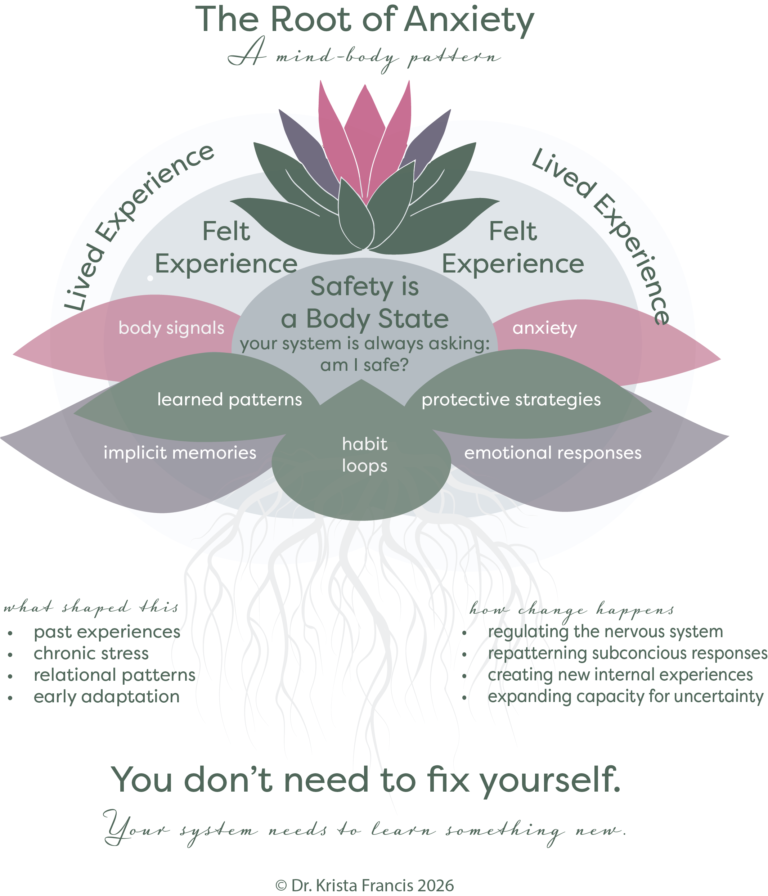
This diagram above illustrates how anxiety develops through interacting brain–body processes, including felt experience, memory, and patterned responses.
What Is the Root Cause of Anxiety?
From a neuroscience perspective, the root cause of anxiety is not a single thing.
It is a patterned interaction between top-down and bottom-up processes in the brain.
- Top-down processes involve thinking, interpretation, and meaning-making
- Bottom-up processes involve emotional and sensory signals coming from the body
These systems work together to help you respond to the world. But when they become dysregulated, your system can become biased toward threat—even in safe situations.
Research describes anxiety as a shift in these processing dynamics, where emotional and sensory signals begin to dominate interpretation (LeDuke et al., 2023).
This is why anxiety can feel so immediate and hard to control.
It isn’t just something you think.
It’s something your system is predicting and responding to automatically.
Why Anxiety Feels Physical (Not Just Mental)
One of the clearest indicators of the root cause of anxiety is this:
You feel it in your body first.
This happens because of a process called interoception—your brain’s ability to sense and interpret internal bodily signals like:
- heart rate
- breath
- tension
- gut sensations
These signals are not passive. They actively shape your emotional experience.
Interoception creates a continuous feedback loop between the brain and body, forming your sense of safety and internal state (Schmitt & Schoen, 2022; Gupta & Chaudhuri, 2026).
When these signals are interpreted as unsafe, anxiety emerges as a felt experience.
This is why:
- you can “know” you’re safe
- but your body doesn’t feel that way
The root cause of anxiety is not just cognitive—it is physiological and sensory.
The Nervous System and the Experience of Safety
Your nervous system is constantly scanning for cues of safety or threat.
This process happens automatically and below conscious awareness.
According to Polyvagal Theory, feelings of safety are not just emotional—they are biological states regulated by the autonomic nervous system (Porges, 2022).
When your system detects safety:
- your body supports calm, connection, and regulation
When it detects threat:
- it shifts into protection (fight, flight, or shutdown)
If your system has learned that the world is unpredictable or overwhelming, it may remain in a protective state—even when your current environment is safe.
This is a key part of the root cause of anxiety:
your system is responding based on learned patterns, not just present reality.
How Anxiety Patterns Form in the Brain and Body
Over time, repeated responses become automatic.
Your system learns what to expect—and prepares for it.
This is how anxiety becomes a pattern.
Research on habits shows that much of human behavior operates automatically, shaped by repetition and context rather than conscious control (Stojanovic & Wood, 2024).
In anxiety, this can look like:
- rapid emotional reactions
- overthinking loops
- heightened sensitivity to threat
These are not choices.
They are well-practiced neural and physiological patterns.
Why Anxiety Doesn’t Change Through Insight Alone
Understanding anxiety can be helpful.
But many people notice that insight alone doesn’t fully shift how they feel.
That’s because the root cause of anxiety is not just in conscious awareness.
It involves:
- automatic nervous system responses
- internal sensory processing
- learned patterns over time
When change is attempted only at the level of thought, it often doesn’t reach the deeper systems where anxiety is maintained.
A Different Way to Understand the Root Cause of Anxiety
What if anxiety isn’t something to eliminate?
What if it’s something your system learned—through experience, adaptation, and repetition?
From this perspective:
- anxiety is not a flaw
- it is a pattern
- and patterns can change
The brain and body are capable of adaptation. The same processes that create patterns can also reshape them over time.
Can You Heal the Root Cause of Anxiety?
Change does not happen through force.
It happens through new experiences that your system can register as safe.
This includes:
- regulating the nervous system
- shifting internal signals
- creating different emotional experiences
- gradually updating patterns
Over time, these experiences can begin to reshape how your system responds.
Not instantly.
But steadily.
A Calm, Grounded Next Step
If you’re ready to work with the root cause of anxiety—not just manage symptoms, you’re welcome to explore working together.
Or, you can continue reading about how anxiety lives in the body in the next article on felt experience.
FAQ: Root Cause of Anxiety
What is the root cause of anxiety?
The root cause of anxiety is a combination of nervous system dysregulation, interoceptive signals, and learned patterns in the brain and body that create automatic responses to perceived threat.
Why does anxiety feel physical?
Anxiety feels physical because it is shaped by interoception—the brain’s interpretation of internal bodily signals like heart rate, breath, and tension.
Can anxiety patterns change?
Yes. Because of neuroplasticity, the brain and nervous system can learn new patterns over time through repeated experiences of safety and regulation.
References
LeDuke, D. O., Borio, M., Miranda, R., & Tye, K. M. (2023). Anxiety and depression: A top-down, bottom-up model of circuit function. Annals of the New York Academy of Sciences, 1525(1), 70-87. https://doi.org/10.1111/nyas.14997
Schmitt, C. M., & Schoen, S. (2022). Interoception: A Multi-Sensory Foundation of Participation in Daily Life. Frontiers in Neuroscience, 16, 875200. https://doi.org/10.3389/fnins.2022.875200
Gupta, D. K., & Chaudhuri, A. (2026). Interoception and Internal Sensing: A Forgotten Layer of Physiological Regulation. BLDE University Journal of Health Sciences, online first, 1-3. https://doi.org/10.1177/2468838X261422326
Porges, S. W. (2022). Polyvagal Theory: A Science of Safety. Frontiers in Integregrating Neuroscience, 16, 87122. https://doi.org/10.3389/fnint.2022.871227
Stojanovic, M., & Wood, W. (2024). Beyond deliberate self-control: Habits automatically achieve long-term goals. Current Opinion in Psychology, 60, 101880. https://doi.org/10.1016/j.copsyc.2024.101880
